
Why CEOs Are Becoming Political Targets and How Protection Must Evolve
A more proactive, intelligence-led approach is needed to identify risk earlier and respond before it escalates
May 13, 2026




The risk profile of today’s CEO has fundamentally changed.
Recent incidents involving high-profile leaders like Sam Altman are putting something into sharper focus for security teams: the threats organizations face today are not only evolving; they are emerging faster and from places that traditional protection models were never designed to address.
At the same time, expectations around executive visibility have grown. Leaders are more public-facing, more vocal, and more closely tied to how their organizations are perceived. That combination is creating new challenges for teams responsible for keeping them safe.
Many organizations are still operating with protection models built for a more predictable environment. The gap between how risk is forming and how it is being managed is starting to widen.
Executives as targets in an accelerated risk environment
Politically motivated violence toward executives is not a new dynamic, but it is happening at a different scale and speed.
As political polarization, ideological movements, and online communities converge, executives are more likely to become proxies for broader grievances. They represent their companies, their industries, and are increasingly expected to take positions on public issues. All of this expands the risk surface in ways that are harder to predict.
The UnitedHealthcare case brought this into sharp focus. The response to the killing of CEO Brian Thompson quickly moved beyond the individual and toward wider frustrations with the healthcare industry, showing how easily an executive can become a symbol of something much larger.
But what has changed most is the pace. Once an executive becomes part of a broader narrative, escalation can happen quickly. Conversations form, spread, and gain traction across digital platforms in real time, often before there is a clear signal that something is moving beyond noise.
For security teams, the challenge is not a lack of information. It’s distinguishing which signals indicate genuine escalation, taking action on them, and turning that data into the nuanced situational awareness leaders need to make fast, informed decisions.
“The internet allows ideological influencers to put forth grievance narratives and to radicalize, recruit, and operationalize people in ways we never saw 40 years ago.”
— Scott Stewart, SVP of Protective Intelligence, TorchStone Global
How to start evolving your executive protection program
If the risk is forming earlier, moving faster, and showing up in new places, your approach to protection has to evolve with it.
The industry is heading in a clear direction. The most effective programs are more proactive, more intelligence-led, and better connected across the business. They combine digital visibility with human judgment and are able to turn complex signals into clear, actionable insight.
But most teams are not starting from a blank slate. You are likely working with existing processes, limited resources, and increasing expectations from leadership. Trying to overhaul everything at once is not realistic.
The shift happens over time. It comes from making practical changes that improve visibility, strengthen decision-making, and help your team focus on what actually matters.
Here are a few places to start:
01
Move upstream on risk: Get ahead of threatening behavior by paying attention to how situations develop along the Pathway to Violence. Patterns often show up first through repeated fixation on issues, changes in tone, or growing attention around an executive. Start small. Monitor a limited set of executives or issues and build from there. Even modest improvements in early visibility can give you more time to assess and respond.
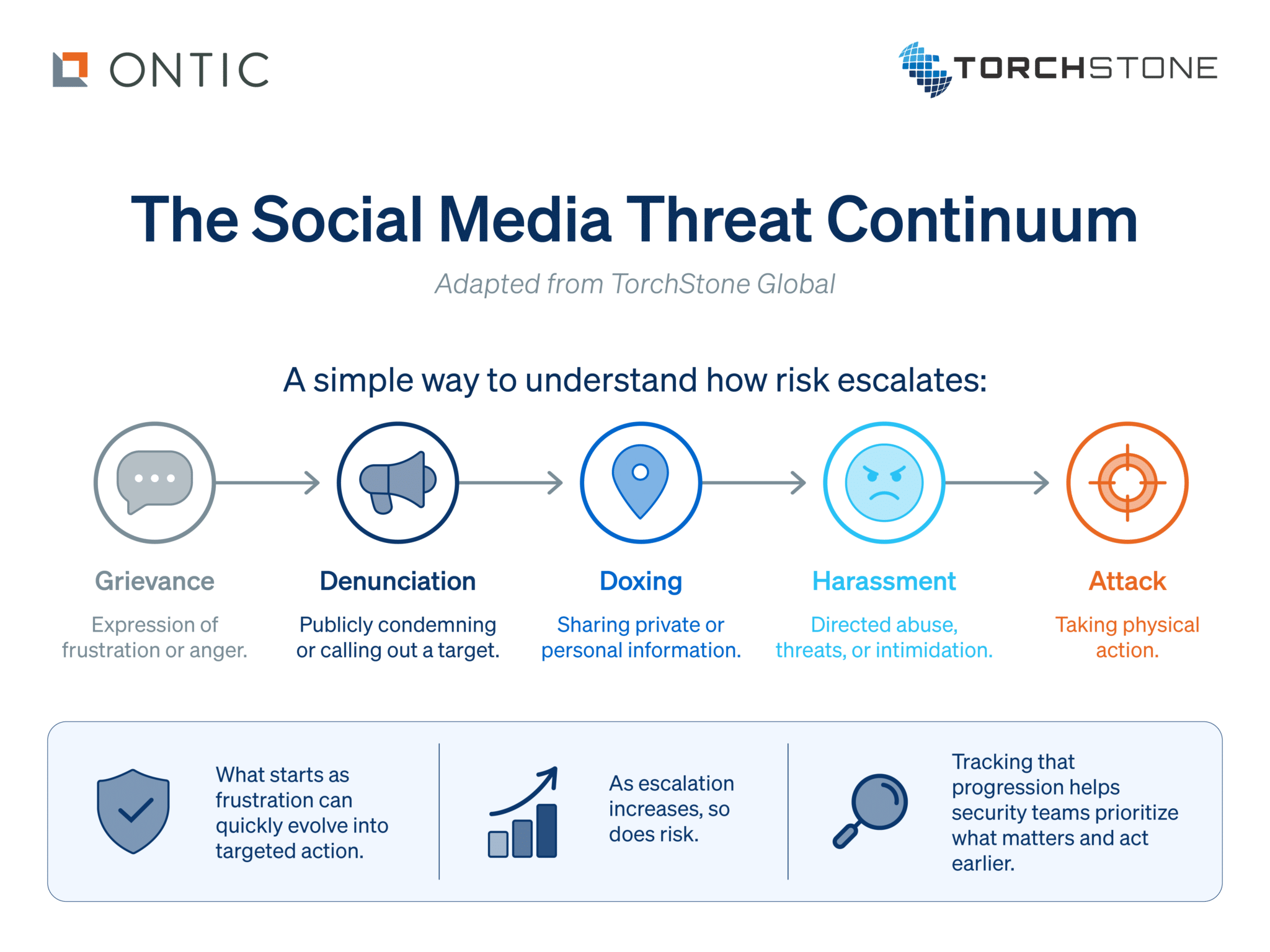
Source: The TorchStone Global Social Media Threat Continuum
02
Make intelligence actionable: Most teams already have plenty of data. The gap is turning it into something useful. Sharpen your outputs to answer one question: why does this matter? Focus on the intelligence that affects executive and business risk, and deliver exactly what leaders need to make informed decisions. Consistency over time builds trust and increases the likelihood that stakeholders act when it matters most.
03
Strengthen relationships across the business: Relevant signals sit across multiple teams, from comms to HR to cyber. If those insights stay siloed, you miss context. Start with simple steps. Build regular touchpoints, create ways to share information, and collaborate on specific issues. Over time, those connections give you a much clearer view of risk.
04
Expand beyond physical protection: Executive risk now includes digital exposure, personal data, and family considerations. Online activity can quickly translate into real-world concerns. But you do not need to solve everything at once. Start by monitoring online exposure or reviewing an executive’s digital footprint. Expand from there as your program matures.
05
Bring risk into business conversations: Executive risk is increasingly tied to reputation and business continuity, but it does not always get treated that way. Make the connection clear. Frame risk in terms of business impact and share examples that resonate with leadership, such as how a seemingly small incident can quickly escalate into reputational damage or operational disruption. Consistent communication builds awareness and support over time.
06
Use AI to extend your team: Most teams are being asked to do more without additional headcount. AI can help by taking on the manual work that slows teams down, like collecting information, sorting signals, and flagging what might matter. Used well, it helps surface patterns faster and ensures important signals are not missed.
The key is to use it where it adds the most value: streamlining manual workflows and prioritizing relevant signals. Ultimately, the goal is for AI to support analysts, not replace them.


A defining moment for executive protection
Executive targeting reflects broader changes in how risk forms and spreads. It is more visible, more complex, and moves faster than it used to.
There is no single fix, but there is a clear direction. Organizations that move toward a more proactive, intelligence-led approach will be better positioned to manage this shift. Those that do not will continue to face gaps in visibility and response. Making that progress comes down to connecting information, aligning teams, and acting on insight quickly.
“That protective intelligence capability is what allows you to become proactive and not just reactive. Once that bullet’s fired, you’re not putting it back in the gun.”
— Scott Stewart, SVP of Protective Intelligence, TorchStone Global
That is where Connected Intelligence matters. Top executive protection companies like Ontic help bring together data, people, and workflows so security teams can identify risk earlier, collaborate more effectively, and make faster decisions when it matters.