
Measuring Program Impact: Corporate Investigations
Learn how to track the right metrics to show real business impact — at any stage of program maturity


You already know your investigations program plays a vital role in the success of your business, but key executive decision-makers may not always see what you see. That’s why it’s so critical to prioritize demonstrating the value of your work. It’s how you earn organizational trust and support and secure the resources you need to keep your people and assets safe.
The need to demonstrate impact is especially urgent as workplace violence investigations become a growing focus across industries. With new mandates like California’s workplace violence prevention requirement, organizations are seeing a sharp increase in investigations to identify threats, mitigate risks, and keep employees safe. As the number of these cases rises, so does the compliance burden and the potential cost of noncompliance. The expectation to prove the impact of these efforts has never been higher.
Connecting to the four business metrics that matter
Investigations program metrics should ultimately ladder up to the four business metrics that security directly influences — and that executives care about most. These metrics will help you frame your program not as a tactical function but as an underlying driver of business outcomes.
Within each of the four categories, three maturity stages allow you to track progress over time: foundational, evolving, and optimized. This approach ensures that your metrics remain realistic for your current stage while highlighting how your program delivers increasing value as it matures. In the sections that follow, we’ll connect each maturity stage to the four business metrics, giving you a clear framework to demonstrate impact in terms that leaders will recognize.
The framework below highlights the key corporate investigations business driver metrics, organized by maturity level.
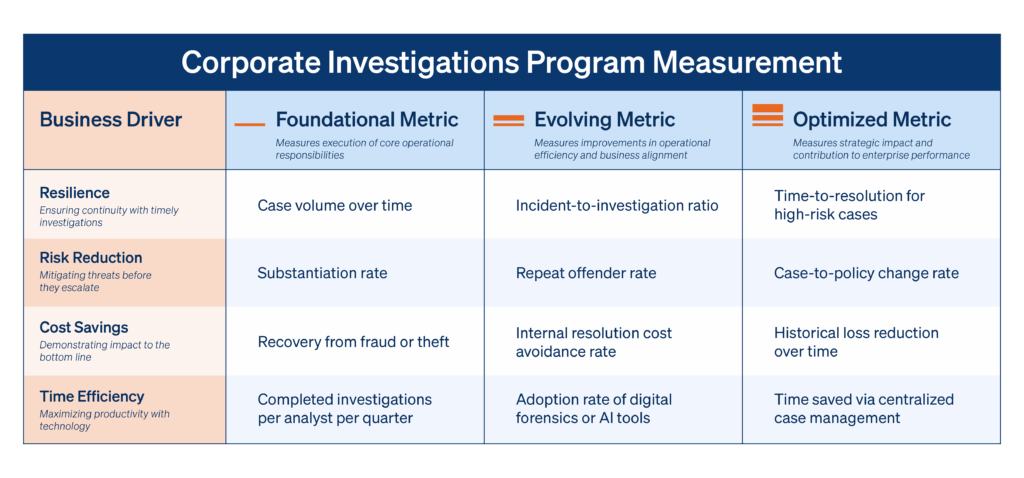
Let’s walk through each of these metrics in more detail.
01
Resilience metrics
Resilience reflects how well your organization recovers from incidents. For you, this means resolving cases efficiently, which minimizes disruptions and ensures operational continuity.

Case volume over time
- What it is: The total number of cases opened over a defined period to understand workload trends and capacity pressures.
- How to track it: Log all cases by open date in a centralized system and track monthly or quarterly volume to monitor patterns in case types.
- Why it matters to the business: This metric helps demonstrate the need for corporate investigation resources, reveals emerging risk trends, and provides tangible evidence of the team’s role in protecting the business.

Incident-to-investigation ratio
- What it is: The percentage of initial reports that are escalated into formal investigations.
- How to track it: Log all incident reports submitted through hotlines, reporting tools, or partners. Calculate the percentage that are escalated into investigations and analyze by source or category.
- Why it matters to the business: Tracking the percentage of incident reports that escalate to investigations helps demonstrate the quality of reporting and the team’s focus on credible, high-risk issues. It also shows how effectively the team filters signals from noise, ensuring resources are spent on matters that truly impact the business.

Time-to-resolution for high-risk cases
- What it is: Resolution speed for critical, high-impact investigations that pose heightened organizational risk.
- How to track it: Classify cases by risk at intake and track resolution time for high-risk cases to identify trends and benchmark performance over time.
- Why it matters to the business: Demonstrates your team’s ability to respond quickly when business stakes are highest. It reflects operational agility and helps build trust that your team can contain serious threats before they escalate.
At the optimized level, your team might build a priority-based triage model that cuts resolution time for critical cases from 12 to 6 days. This accelerates business continuity, reduces exposure, and frees up resources for higher-value work. In some cases, containing a breach six days sooner can prevent costly fines or reputational damage — outcomes executives care about because they directly protect revenue and brand value.
02
Risk reduction metrics
Reducing organizational risk is one of the clearest ways to demonstrate ROI. Your investigations team plays a unique role in identifying root causes, creating solutions, and preventing recurrences.
Substantiation rate
- What it is: The percentage of investigations that result in actionable findings.
- How to track it: Log total completed investigations, track substantiated outcomes, and calculate the substantiation rate over time.
- Why it matters to the business: Shows how often investigations confirm real issues, highlighting the team’s effectiveness in validating credible risks. It reinforces the value of the program by demonstrating that investigative efforts are uncovering meaningful, actionable findings that protect the business.
Percentage of repeat offenders
- What it is: The percentage of threat actors or entities that appear in multiple investigations, signaling repeat risk exposure.
- How to track it: Maintain a centralized threat actor database to track repeat individuals or groups over time, categorizing them by risk level and affected business unit.
- Why it matters to the business: Tracking the percentage of repeat threat actors highlights where risks are not fully resolved, demonstrating your team’s critical role in surfacing systemic issues and implementing proactive protections to mitigate top threats.
“A well-maintained POI database doesn’t just track individuals of concern — it helps you identify your top 10 repeat POIs and the people they’re targeting. Just as importantly, it highlights the top 5 or 10 employees who are most frequently targeted, so you can implement enhanced protections and proactively reduce risk.”
— Farhad Tajali, Ed.D., SVP, Global Head of Safety and Security, Creative Artists Agency
Case-to-policy change rate
- What it is: How often investigation outcomes lead to changes in policy, process, or internal controls to prevent future risk.
- How to track it: Tag cases that drive broader corrective actions (like policy revisions, new training, process redesign) and track the percentage of investigations leading to these systemic improvements.
- Why it matters to the business: Tracking this metric shows your program drives meaningful change, strengthens governance, and reduces organizational risk. It demonstrates your program’s role as a proactive partner in enterprise risk management.
At the optimized level, your analysis might show that 20% of substantiated cases stem from gaps in third-party oversight. Acting on that insight, you recommend a stronger vendor due diligence process, cutting vendor-related incidents by 40% the following year — a measurable, organization-wide improvement. Executives value these outcomes because they strengthen operational resilience and reduce enterprise risk exposure.


03
Cost savings metrics
Executives care deeply about cost savings. Whether through prevention, recovery, or operational efficiency, your work directly influences the organization’s financial health.
Recovery from fraud or theft
- What it is: The total value recovered through investigations into fraud, theft, or misappropriation.
- How to track it: Log all cases involving financial loss or asset theft and record amounts recovered through restitution, asset return, or reimbursement. Track over time and compare against estimated losses, where available.
- Why it matters to the business: Demonstrates the tangible financial return of investigative work and validates your team’s impact in protecting company resources.
Internal resolution cost avoidance rate
- What it is: Compares the number of cases closed internally vs. those that would have escalated to external litigation or regulatory action, and the cost avoided by doing so.
- How to track it: Track the number of cases resolved internally without requiring outside legal counsel or external enforcement. Estimate the cost difference between internal resolution and likely external outcomes (like legal fees, settlement costs, fines).
- Why it matters to the business: Demonstrates the financial value of resolving issues internally by reducing reliance on costly external legal channels and capturing avoided expenses. Shows how strong in-house investigative processes lead to faster, more efficient outcomes.
Historical loss reduction over time
- What it is: This metric uses historical case data to measure trends in how investigations have reduced the total volume or value of loss across the organization.
- How to track it: Aggregate multi-year data on losses from fraud, theft, or misconduct and correlate changes in loss frequency or severity with investigation trends, response protocols, or policy updates. Segment by business unit, case type, or region to identify patterns.
- Why it matters to the business: Highlights the long-term impact of investigations in lowering enterprise risk and financial exposure. It demonstrates that smarter processes are driving measurable prevention and positions investigations as a key component of strategic risk management.
For example, imagine you’re tracking historical loss reduction over time. Over three years, losses tied to internal theft drop from $800,000 to $250,000 after implementing enhanced fraud detection, policy changes, and a stronger reporting culture. These trends provide compelling, long-term proof of impact. Since operations and finance leaders are laser-focused on cost reduction, demonstrating that your team drives measurable savings clearly aligns security with the organization’s strategic priorities.
04
Time efficiency metrics
Time efficiency is essential for scaling your impact. By focusing on process improvements and smart resource allocation, you can improve productivity without overextending your team.
Completed investigations per analyst per quarter
- What it is: This measures individual workload and output across your investigations team to establish a baseline for productivity.
- How to track it: Track the total number of cases completed per analyst over a standard period (like quarterly). Compare trends over time or across similar case types.
- Why it matters to the business: It demonstrates how the investigations team is maximizing output without sacrificing quality, proving its value as a scalable and resource-efficient function within the business.
Adoption rate of digital forensics or AI tools
- What it is: Measures the adoption of time-saving technologies that support tasks like evidence analysis, case triage, or pattern recognition.
- How to track it: Log usage of specific AI and automation tools, track adoption rate across team members and workflows, and measure time reduction or case acceleration where possible.
- Why it matters to the business: Demonstrates that your team has evolved to focus on higher-value analysis and strategy without adding overhead costs. Enhances accuracy, consistency, and speed of investigative tasks.
Average time saved via centralized case management
- What it is: Quantifies time savings from using integrated platforms for intake, documentation, communication, and resolution tracking.
- How to track it: Compare time-to-resolution before and after the implementation of a centralized case management system. Calculate the average reduction in hours per case or per workflow stage.
- Why it matters to the business: Demonstrates how streamlined workflows powered by the right technology accelerate case resolution, reduce backlog, and enhance the organization’s ability to respond to risk quickly. This ultimately justifies technology and resource investments.
For example, suppose you implement a new system that saves your team 150 hours per quarter by connecting incident intake, research, investigations, and reporting. At $80/hour, that’s $12,000 per quarter in labor value, which you can reinvest in proactive investigations or analyst training. Executives care about these efficiencies because they directly translate to cost savings and improved resource utilization.
Meeting your team where they are
Not every investigation team has the resources or tools to operate at the optimized level yet. That’s okay. What matters most is using foundational metrics to gain visibility into your team’s current performance, and leveraging those insights to evolve over time.
Begin by identifying which level your team currently operates at across each business driver. Then, set measurable goals for improvement, focusing on incremental next steps. For example, moving from foundational to evolving metrics might involve investing in basic case management software. Advancing to optimized metrics may include adopting advanced systems that integrate research with investigations workflows, or platforms rooted in AI and automation.
Meeting internally with your team to discuss metrics and identify trends over time as a group is also a great way to spot areas of improvement. These dedicated sessions encourage collaboration, spark new ideas, and create space to reflect on how your tracking efforts can evolve — helping your program grow more strategic over time.
“Scheduling a monthly or bi-monthly security metrics review internally is a game-changer. I do that with my team. This allows everyone to present their metrics to the rest of the team, identify and discuss trends and insights, and compare to the previous month or quarter to assess the progress or any deviation from baseline.”
— Farhad Tajali, Ed.D., SVP, Global Head of Safety and Security, Creative Artists Agency
Securing your seat at the leadership table
Your investigations team plays a critical role in protecting the business — preserving reputation, avoiding financial loss, and keeping operations on track. You know that. But leadership doesn’t always see the full impact.
The key? Find the one thing your stakeholders care about most — whether it’s reducing risk, cutting costs, or saving time — and build your team’s story around it. When you align your work with what matters to the business and communicate it clearly, you don’t just earn trust — you build influence. No matter where you’re starting from, every step forward makes your impact more visible, more strategic, and more valued.